A way to see what words do to the people who hear them.
Writing a sentence is almost free now. Knowing what it will do to a particular person is not.
A sentence matters because of what it generates in the person who receives it: confidence. They come away a little more sure, or a little less sure, of something they will later act on. That small transaction runs courts, legislatures, markets, classrooms and families. The score of that transaction exists. Until now, the instrument to read it did not.
Labels were the ceiling
Aristotle named ethos, pathos, logos and kairos. Two thousand years later, Robert Cialdini named six principles of influence. Both are labels. A label tells you a lever is present; it cannot tell you how hard it presses, on whom, or when. Fields stall at the label stage until an instrument arrives: alchemy became chemistry with the balance scale, and astrology became astronomy with the telescope.
Aristotle named forces of persuasion. We measure them.
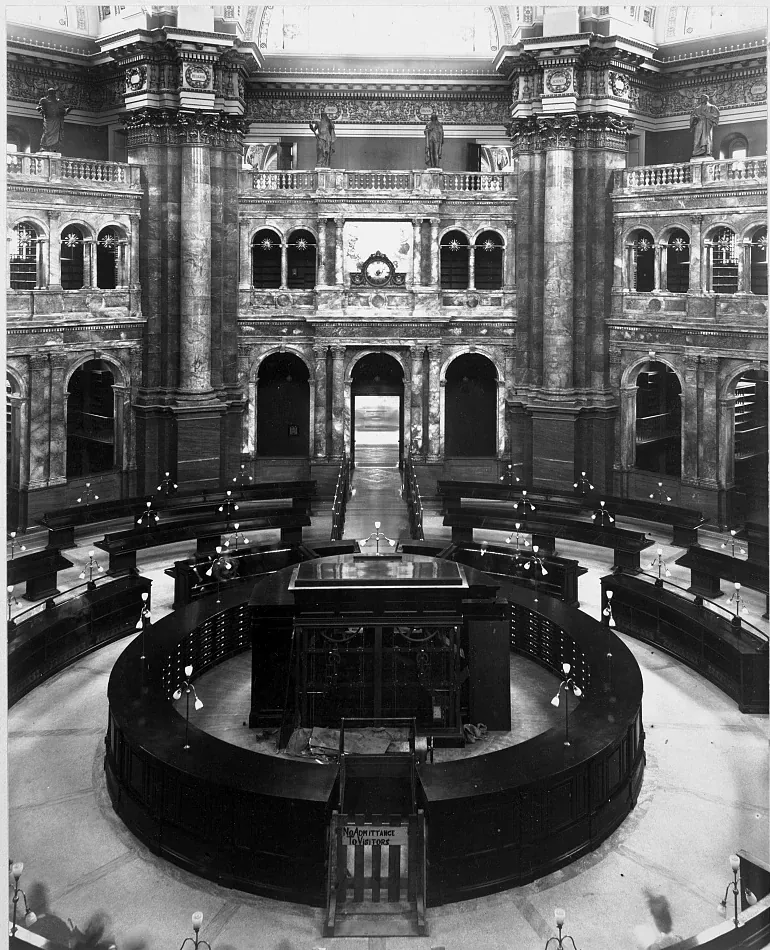
1895The Main Reading Room of the Library of Congress. Twenty-four centuries of writing about persuasion, almost all of it labels.Library of Congress, no known restrictions on publication.
The instrument, rung by rung
SignalThe message, in order: text by position, audio by time, video by frame.
Rhetorical MassHow much was said: claims, entities, structure, fallacies. The same text always gives the same mass.
Persuasive VelocityHow well it was said, across eight channels, down to leaves that each carry a score and its stated reasons.
Momentum and forceWhat moved. Force is what it takes to change the course of a conversation.
The personaWho is listening: who they are, what moves them, their state of mind, their setting.
Persuasive ResonanceDid it land? Four probabilities, one person, one message, one moment.
Eight channels
Ethos
Do I believe the source?
Pathos
Does it reach me through feeling?
Logos
Do the steps connect?
Kairos
Is this the right moment, at every scale?
Style
How vividly is it put?
Clarity
Does it feel easy to grasp?
Focus
Does it capture and hold attention?
Awareness
Do I see the move as a move? The channel Pulp cares about most.
Did it land?
At the top of the instrument, a message meets a person, and the readout reports four probabilities that always sum to one: that they take it in and find it valid, find it invalid, take it in and withhold judgment, or never perceive it at all.
ValidInvalidAbstainCannot compute
An illustration, not a result. Every number in a real readout carries its stated reasons.
In 2019, valid and invalid were buttons people pressed on each other's arguments. Now they are a measurement. Every score is computed against a goal someone stated, which is what makes it comparable, auditable and fair to argue with.
The loop that learns
A conversation is a graph: replies, support and attack, with momentum flowing along the edges. Pulp is building a graph neural network that lives on that structure, compares its readings with what actually happened, and corrects itself. The firms that measure outcomes have no mechanism. The firms that generate language have no measurement. Pulp is building the loop between them, and the layer that ties every score to its reasons.
The Long Argument
Humanity has been assembling a jigsaw puzzle for four thousand years without knowing it.
Shah's history of persuasion follows one hundred people who each built one part of this instrument, from Ptahhotep in Egypt around 2400 BCE to the researchers who wrote "Attention Is All You Need" in 2017. A vizier, a slave, a monk, a lens grinder, a telegraph engineer, a psychologist counting other people's mistakes. None of them could see the picture on the box.
The hundred-and-first piece, in the middle of the spiral, is the one Pulp is building now. The whole timeline is one of the pieces on this site you can only reach by rolling the dice.
Where the work has been presented
Emory University
MSBA program speaking event, January 2026.
American Sociological Association
New York, August 10, 2026: fentanyl policy language across election cycles, with Nan Li of the University of Florida.
University of Florida
Three seminars with the Computational Sociology and Criminology Lab, September 22 and 23, 2026.
INFORMS
Annual Meeting, San Francisco, November 1 to 4, 2026. Accepted.
American Society of Criminology
Chicago, November 18, 2026: from policy to posts to comments.
Picture credits
Library of Congress, Prints and Photographs Division: Main Reading Room, Library of Congress, 1895, L. C. Handy, photographer. No known restrictions on publication.